
Paella valenciana vs seafood paella: differences and which to order in Barcelona
If you are visiting Barcelona and want to eat paella, the first question you will face is which one to choose. Paella valenciana and seafood paella are the two most well-known varieties — and also the most frequently confused. They have different ingredients, different flavours and different origins. In this article we explain the real differences so you know what you are ordering and, more importantly, what to look for when you want a genuinely good paella in Barcelona.
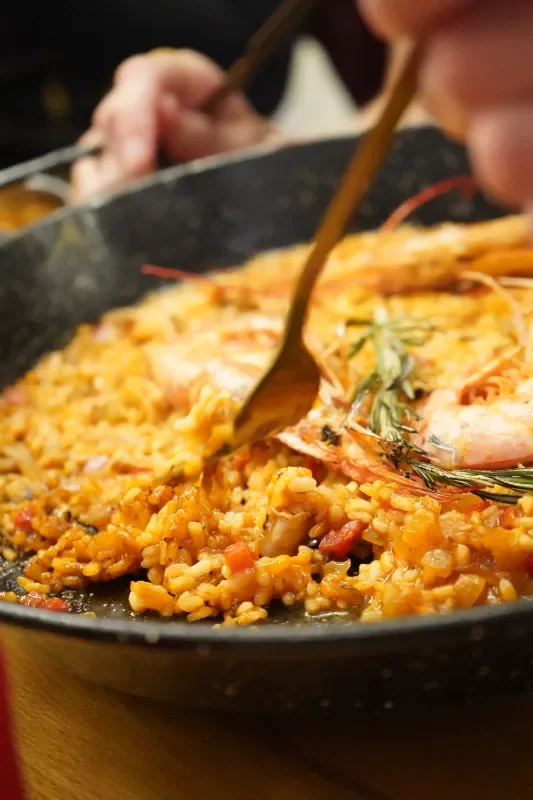
What is paella valenciana?
Paella valenciana is the original version. It was born in the farmlands around Valencia in the 19th century as a dish that farmers cooked with whatever they had available: chicken, rabbit, green beans, garrofón beans, tomato, saffron and rice. No seafood. No fish. No fish stock.
It is a dry rice dish with separate, well-defined grains cooked in a meat-based stock. The flavour is deep but restrained — it does not shout, it convinces. The socarrat, the toasted crust that forms at the bottom of the pan, is its most recognisable feature.
Paella valenciana has a protected recipe and a specific list of authorised ingredients. Adding seafood to it is, for many Valencians, a culinary offence with a proper name.
What is seafood paella?
Seafood paella is a more modern variant that became popular along the coastal regions of Spain — particularly in Catalonia, the Levant and the islands — where access to fresh seafood was abundant.
Its main ingredients are prawns, mussels, clams, crayfish and squid, cooked in an intense stock made from rockfish and shellfish. The result is a rice dish with a powerful flavour of the sea, slightly moist in the centre and with socarrat at the base when it is well executed.
It does not have the historical heritage of the Valencian version, but it has something many people prefer: an intensity of flavour that is hard to ignore.
Key differences between the two
The differences are not just about ingredients. They affect the stock, the flavour, the texture and the overall experience.
Stock base: paella valenciana uses meat stock or water with the chicken and rabbit. Seafood paella uses rockfish fumet, which gives a completely different depth of flavour.
Protein: chicken and rabbit in the Valencian version. Prawns, mussels, clams and squid in the seafood version.
Rice texture: both should have separate grains, but seafood paella tends to be slightly more moist in the centre due to the liquid released by the shellfish as they open.
Flavour: paella valenciana is more earthy and mineral. Seafood paella is more intensely marine and iodine-forward.
Sofrito: both versions start with a sofrito of tomato, garlic and paprika, but seafood paella often incorporates salmorreta — a paste made from ñora peppers, garlic and roasted tomato that adds greater complexity to the base.
Which one is more authentic?
This is the question that generates the most debate. The honest answer is: it depends on who you ask.
For the Valencian school of thought, authentic paella contains chicken and rabbit. Full stop. Everything else is rice with things in it.
For most contemporary cooks and food writers, authenticity lies not in the ingredients but in the technique: a well-made sofrito, quality stock, the right point of the rice and a proper socarrat. A seafood paella executed with skill and good ingredients is as authentic as any other.
What is clear is that the paella you find in many tourist restaurants — made from frozen ingredients, without socarrat, with overcooked rice — is neither of the two. It is something else entirely.
Which should you order in Barcelona?
In Barcelona, seafood paella is the most common variant and the one that fits most naturally with the city's market-driven cooking tradition. Access to fresh Mediterranean seafood and the strong marine cooking culture make it the most logical choice when you are on the coast.
That said, finding a good paella in Barcelona — of any kind — requires knowing where to look. The city has an enormous offer, but also a lot of noise.
Some signs that you are in the right place: the rice is cooked to order and not prepared before you arrive, the restaurant does not have a fifty-dish menu, and the price per person reflects the real cost of the ingredients. A good seafood paella cannot be cheap if the seafood is fresh.
How to recognise a good paella in Barcelona
Beyond the type, these are the indicators we consider most reliable:
The socarrat is there. A well-made paella has a toasted crust at the bottom — not burnt, not absent. If the rice arrives without socarrat, someone took a shortcut.
The rice has the right point. Not overcooked, not hard. The grain should be fully cooked but still intact, with a slight bite to it.
The stock has its own flavour. Taste the rice on its own. If the base has no flavour, the seafood was frozen or the stock came from a packet.
No foam or leftover liquid. A properly executed paella absorbs all the liquid during cooking. If there is stock left in the pan, something went wrong with the proportions.
Learn to cook your own paella in Barcelona
If you want to truly understand the difference between one paella and another, the best way is to cook it yourself. At Rice To Meet You we offer hands-on seafood paella workshops in Barcelona where each participant cooks their own paella from start to finish, guided step by step.
We use Albufera D.O. Valencia rice, our own homemade fumet and salmorreta alicantina as the base of our sofrito — a combination that gives the rice a depth of flavour that is difficult to find elsewhere in the city.
f you are interested, you can book your place at our seafood paella cooking class in Barcelona.