
Authentic Paella in Barcelona: The Honest Guide for 2026
There are over 10,000 restaurants in Barcelona. Hundreds of them serve paella. Most of it is not the real thing.
That's not a controversial statement — it's a practical problem that affects almost every visitor to the city. Reheated rice, frozen seafood, powder-based broth, and rice scooped from a tray in the back. All of it served in a nice bowl, at a table with a view, for €18 a head. And you'd never know the difference unless someone told you.
This guide tells you. And then it tells you something better: how to skip the whole problem entirely.
Why bad paella is so common in Barcelona
Paella is Valencian, not Catalan. Barcelona doesn't have a traditional paella of its own, which means the version that landed here largely came through the tourism industry — adapted for speed, cost, and volume rather than quality.
A proper paella takes 20–25 minutes of active cooking once the rice goes in. It requires homemade stock, a short-grain DO rice, and a wide shallow paella pan over controlled heat. None of that is cheap or fast. In a restaurant turning over 200 covers a day near Las Ramblas, the economics don't work. So something else fills the gap: precooked kits, low-cost rice, and stock from a packet.
The result is a city with extraordinary food and a paella problem hiding in plain sight.
3 red flags you can spot before you order
You don't need to be a food expert to avoid a bad paella. You need about 30 seconds and these three checks.
1. A paella photo on the menu or at the door
This is the clearest signal in the city. Restaurants that make paella well don't need to show it before you sit down — they let it speak when it arrives. Large paella photos at the entrance, on laminated menus, or on a board outside are almost always a sign that the product is standardised and the target customer doesn't know what to expect.
2. Paella served on a plate
The red flag isn't the individual portion. It's the plate.
Paella is cooked and served in the paella pan: the wide, shallow vessel the dish is named after. That doesn't depend on how many people are eating. A paella for one is made in a small pan, and it comes to the table in it.
If the rice arrives already plated, it's because it was cooked earlier in bulk, portioned out and reheated. It reaches you in five minutes, soft-grained and with no socarrat, because it has been sitting for hours. The plate is the tell: the pan stayed in the kitchen because it was never used for you.
And don't fall for the idea that a smaller portion cooks faster. It doesn't. The rice sets the clock, not the pan. A paella for one needs exactly the same 20–25 minutes as a paella for six. So if it lands in five, it wasn't cooked, it was reheated.
So the useful question isn't "do you do individual portions?" but "is it cooked to order, in its own pan?" Anywhere that takes its rice seriously answers without hesitating, and usually you can watch it happen from your table.
3. It arrives in under 20 minutes
Once the rice goes into a real paella, it needs 20–25 minutes in the broth — untouched, unstirred — before it's ready. If your order goes in and your plate is back in 10 minutes, the math is simple: it was already cooked. Ask the waiter how long it will take before ordering. A restaurant making it fresh will tell you without hesitatio.
What makes a paella authentic: 4 things that don't lie
THE RICE. The variety matters, but there's no single 'correct' one. What separates a serious paella from a mediocre one is that it's made with a short-grain, DO-certified rice — bomba, senia, and albufera are the reference varieties, each with its own character. At Rice to Meet You, for instance, we cook with Albufera D.O. Valencia rice, prized for how evenly it absorbs stock and how forgiving it is against overcooking. What a paella should never be made with is generic long-grain or low-cost rice — that's where the real difference shows. If the rice is soft, sticky, or uniform in texture, it's likely not a short-grain DO variety, or it's been sitting since it was cooked.
HOMEMADE STOCK (FUMET). The flavour of a paella lives in the liquid, not the rice. A proper base starts with a sofrito — slow-cooked tomato, garlic, and smoked paprika — and builds on that with a homemade fish and seafood stock, or a vegetable stock if the paella is a vegetarian one. If a paella tastes flat or thin, the stock was poor. There's no fixing that with extra seasoning at the table.
THE SOCARRAT. This is the detail that separates a finished paella from an unfinished one. Socarrat is the layer of toasted, slightly caramelised rice that forms at the bottom of the pan in the final minutes of cooking, when the heat is raised and the liquid has evaporated. It's crispy, smoky, and intense. When your paella arrives, press a spoon against the bottom of the pan. If there's resistance and a faint crackle, you have a proper socarrat. If the rice lifts clean, it wasn't finished.
TIME. Paella can't be rushed, and the method is the proof: the stock goes in progressively, the rice cooks in it without being stirred, and the heat drops at the exact right moment. There's also a tell that never lies — a paella that has cooked for the right amount of time smells different. The toasting, the caramelisation, the reduction of the stock into the rice: all of it produces an aroma that a reheated dish simply doesn't have. Trust your nose as much as your eyes.
There's a better option than finding the right restaurant
Here's what most paella guides in Barcelona won't tell you: the most memorable paella experience in the city isn't eating one. It's making one.
Paella has always been a collective act. In the Mediterranean tradition, it's cooked outdoors, over an open fire, with everyone gathered around. The cook isn't separate from the group. The group is the cook. That's where the dish actually comes from — not from a restaurant kitchen, but from a Sunday afternoon with people who know each other, or are about to.
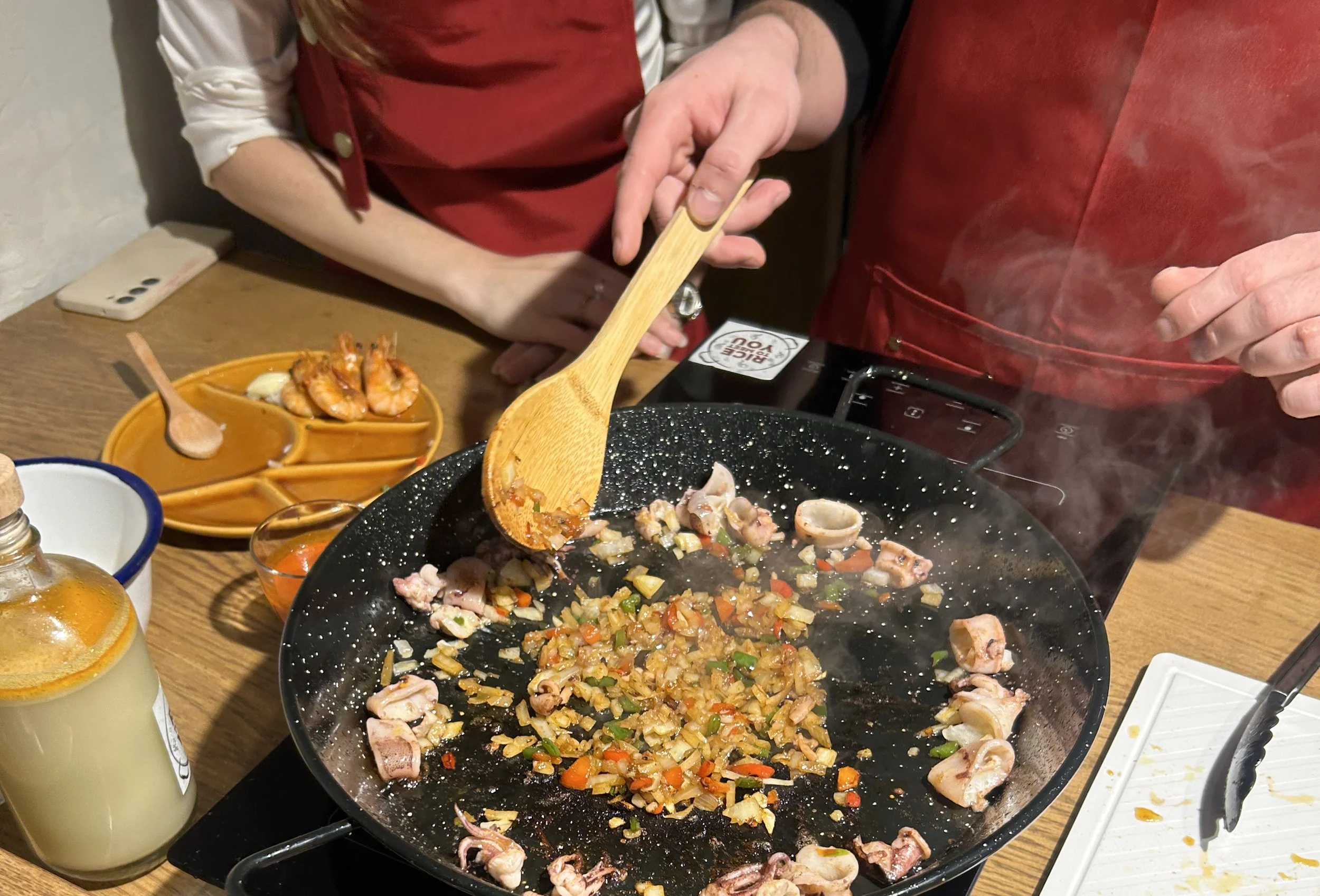
At Rice to Meet You, in the heart of El Raval, that's exactly what we offer: the process, not the plate. You make the sofrito yourself. You add the rice at the right moment. You control the heat. And when the socarrat forms at the bottom of your paella pan, you made it happen. There's no screen between you and the kitchen. You are the kitchen.
No experience needed. No performance anxiety. The session runs for 2.5 hours — from arrival through to the sobremesa, the long unhurried conversation after the meal — and everything is included: ingredients, a welcome glass of cava, the full tasting and dessert. The workshop is led in both English and Spanish. The setting is a carefully designed space in one of Barcelona's most authentic neighbourhoods, a ten-minute walk from Las Ramblas and a world away from it.
Price: €69 per person, VAT included.
→ Book a paella cooking class in Barcelona
The question we hear most: can you actually learn to make paella in two hours?
Yes — in the sense that actually matters. You won't leave as a professional chef. You'll leave knowing what makes a paella real, understanding the technique from sofrito to socarrat, and having made one from scratch with your own hands. That knowledge is immediately transferable: you can replicate it at home, and you'll never look at a restaurant paella the same way again.
More importantly, you'll remember it. That's the difference between a workshop and a restaurant — active memory against passive memory. There's a meaningful difference between remembering that you ate a good paella in Barcelona and remembering that you made one. The second version stays with you.
What to take away from this guide
If it arrives on a plate instead of in its own pan, it was cooked earlier and reheated. The portion size was never the problem.
If it reaches your table in under 20 minutes, nobody cooked it for you. Rice needs 20–25 minutes in the broth, whether it's for one person or six.
Look for the socarrat. Scrape the bottom with your spoon: resistance and a toasted smell mean someone finished the job. No socarrat, no paella.
The flavour lives in the broth, not in the rice. A bland paella is a stock problem, and no amount of good rice will hide it.
If you want the version you'll actually remember, cook it yourself. Two and a half hours in El Raval, from your own sofrito to the last toasted grain.
Rice to Meet You is at Carrer de la Lleialtat 16, El Raval, Barcelona. Workshops run Wednesday to Sunday. Book at ricetomeetyou.fun or via WhatsApp at +34 645 116 730.